Grand Games
The Problem
Grand Park sits in the heart of downtown Los Angeles, flanked by City Hall and the Music Center and surrounded by concrete and commuters. It is a genuinely beautiful public space that most Angelenos pass by without stopping.
The brief came from Grand Park stakeholders working with verynice, a design strategy agency. The ask was to increase public interest and usage of the park, extend its reach to a wider audience, and establish deeper cultural value. The client wanted a solution that blended physical and digital experience, stayed low-cost and scalable, and could be updated continuously without requiring city permits for permanent installation.
The underlying problem was less logistical than cultural. The park was underutilized not because people disliked it, but because it gave casual visitors nothing to do once they arrived and no particular reason to return. Scheduled events drew crowds reliably, but the space between them went largely unclaimed.

My Role
I joined the team after the initial proposal phase, prior to key implementation decisions. My contributions were concentrated in three areas: secondary and observational research, visual design of the game signage and Instagram takeover assets, and copywriting for the game instructions themselves.
One constraint I worked within was geography. Two of our four team members, myself included, were not based in Los Angeles and could not visit Grand Park in person. I conducted remote observation using Google Maps and Street View, navigating the park and surrounding streets virtually and documenting areas of interest through screenshots. This gave me enough spatial understanding of the park to contribute meaningfully to design decisions about signage placement and visibility.


Research

Our research pulled from three directions. We analyzed competing events and interactive public installations to understand what already drew people into shared outdoor spaces. We conducted netnography, reading Reddit threads and Quora discussions about Grand Park and Los Angeles public life, which surfaced a consistent theme: locals feel proud of the city's cultural diversity and respond warmly to experiences that reflect it. And we spoke with two subject matter experts in game design, including David Javelosa, a game development specialist and professor at SMC, who told us directly that physical involvement in an outdoor location would be the most appropriate way to get people engaged.
Three findings shaped everything that followed. People tend to look down while walking, which meant ground-level and eye-level signage placement mattered more than we initially assumed. Long instructions with dense text caused confusion and disengagement. And culturally specific content, when presented accessibly, was a draw rather than a barrier.
Ideation and Design
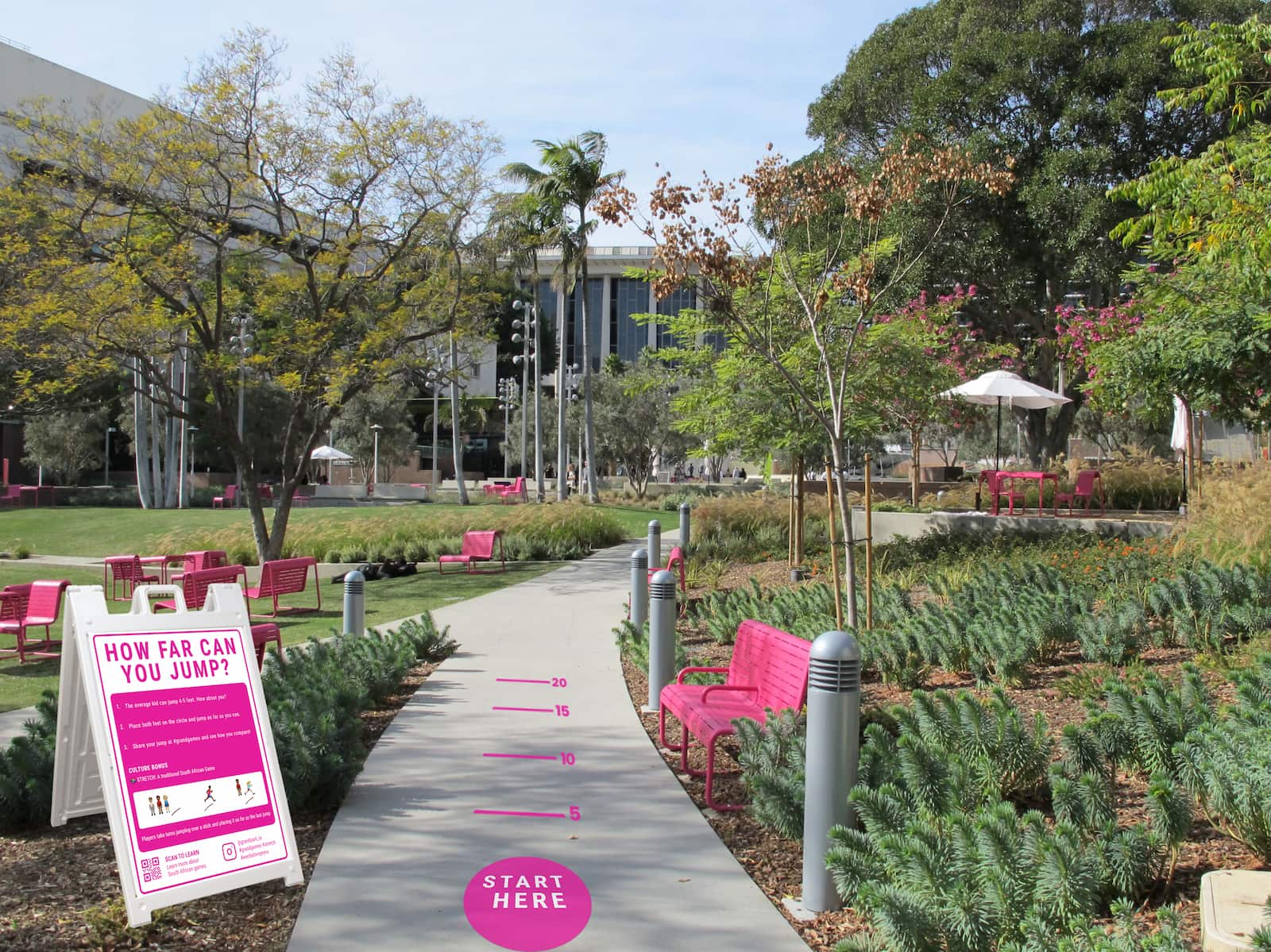
We went through several iterations of the signage before landing on the final system. Early versions were text-heavy and difficult to follow at a distance or while moving. We stripped them down progressively, leading with the game title and a visual summary of play, then presenting numbered steps in plain language, and closing with a Culture Bonus section linking to a QR code with background on each game's cultural origins.


The final signs were designed bilingually in English and Spanish, using Grand Park's existing color palette of hot pink and yellow to feel native to the space rather than imposed on it. Games were selected from a range of cultural traditions to reflect the diversity of Los Angeles rather than defaulting to any single reference point.


We also proposed placing game markings directly on the ground and on park poles to increase discoverability, based on our research finding that visitors often walk with their gaze downward.

Each sign's Culture Bonus section invited visitors to scan a QR code and read the history behind the game they were playing. The goal was to make cultural context feel like a reward rather than a requirement, available to anyone curious enough to look.
Testing and Results
We printed and laminated the final signs and brought them to Grand Park for in-person prototype testing. Participants were recruited on-site. We observed people reading the instructions, attempting the games, and in several cases pulling in bystanders to join. One teen visitor summed up the dynamic: "If I see other people playing it, I'll probably jump in too."


The Instagram takeover campaign reached 6,282 accounts with 7,330 impressions and generated 291 interactions. I designed the visual assets for the campaign. That reach confirmed the concept extended beyond foot traffic at the park on testing day.
Reflection
The team benefited from clear specialization — visual design, game research, and bilingual copywriting stayed in distinct hands, and the deliverables showed it. The remote constraint that applied to two of us produced a research method, Google Street View observation, that we would not have reached for otherwise.
If I were to extend this project, I would focus on the digital layer. The QR codes pointed to cultural history content that was never fully built. That connection between a game played in a park and the tradition it came from is the most interesting part of the concept, and it deserved more than a placeholder.
