
SafeHere
Overview
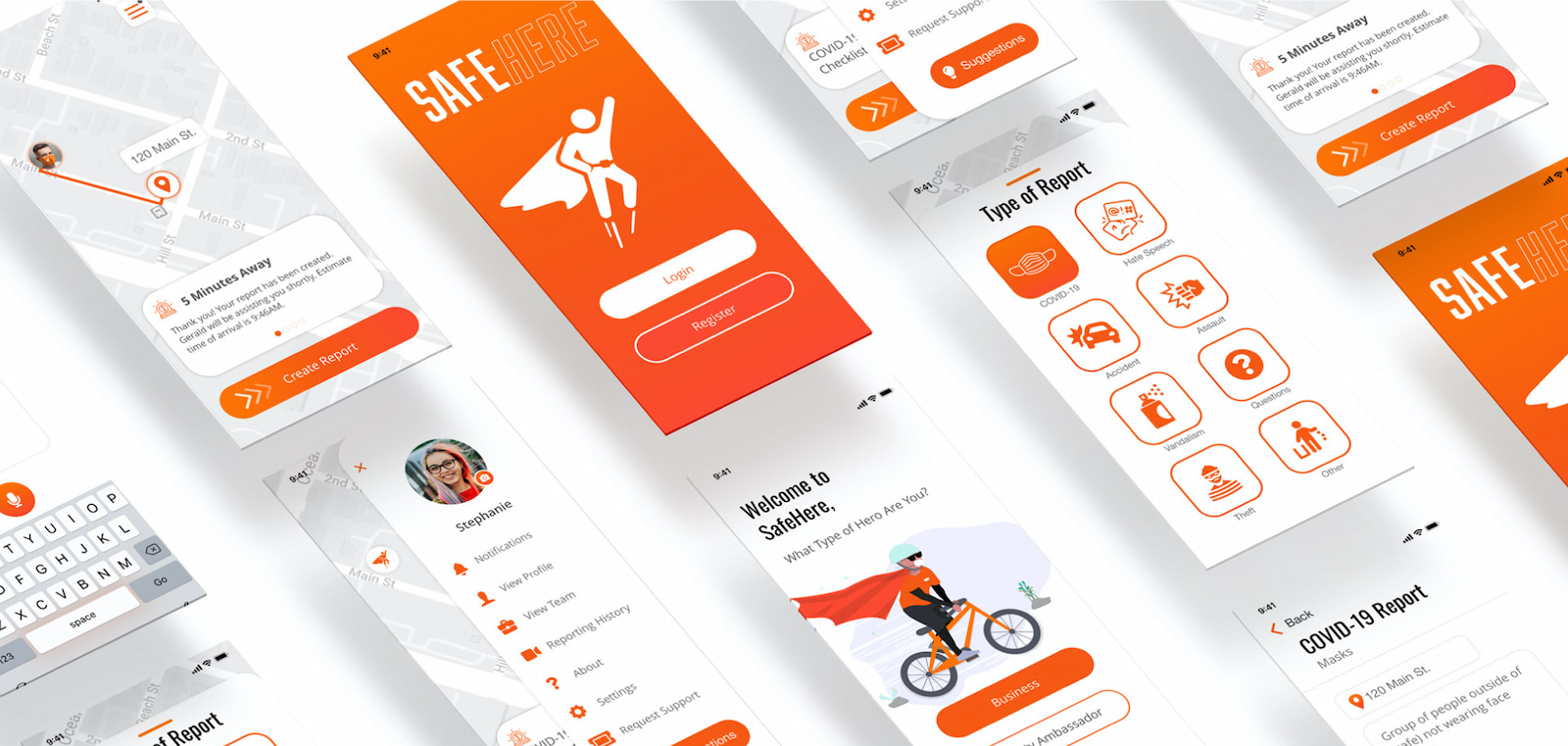
SafeHere is a mobile app that connects business employees along Santa Monica's Main Street to trained safety ambassadors through discreet, real-time incident reporting. The project was built in response to a specific civic problem: during the height of the pandemic, there was no standard way for local businesses to address non-emergency safety concerns, and customers were leaving with complaints rather than resolutions. I led primary and secondary research, contributed to prototype design, and presented our work to the class and invited guests across the 13-week project.
Problem
In 2020, visitors along Main Street felt unsafe near others who weren't following health guidelines, and local businesses had no reliable channel to act on those concerns quickly. Calling the police was disproportionate. Asking employees to handle confrontations directly was unreasonable. The gap between a complaint and a response had no infrastructure.
A 23-person survey we distributed across Reddit, Nextdoor, Facebook, and Ring confirmed what we observed in the field: 64.3% of respondents felt unsafe while visiting the area. Field observation backed that up. Storefronts were vacant or boarded. There was no signage about COVID guidelines or the al fresco dining setup newly installed on the street.


Research and Pivot
Our secondary research surfaced something important. Several cities had already implemented safety ambassador programs for exactly this kind of non-emergency situation, and Santa Monica's Main Street had one.
Competitor research identified two existing tools businesses on Main Street were already relying on. Neither addressed the business side of the communication gap.

Block by Block's SMART System tracked ambassador locations, logged incidents, and maintained a persons-of-interest database for the ambassador program.
Gap
Businesses had no ability to create a report or request an ambassador directly.

The City of Santa Monica offered a directory of department phone numbers for businesses to report operational or safety concerns.
Gap
No online platform existed. Reaching the right contact required navigating the website, finding the correct number, and waiting on hold.
The initial design direction was a two-way communication app between visitors and safety ambassadors, but feedback during research pushed us to reconsider. If any visitor could report any other visitor, the app risked functioning as a surveillance tool, empowering people to police who belongs in public space. We pivoted. By routing reports through business employees rather than the general public, we introduced a layer of accountability that reduced the risk of discriminatory or retaliatory use.

Understanding Users
To keep the work grounded, we built a persona around Stephanie Griffin, a 20-year-old Starbucks employee on Main Street. Her core tension was simple: she needed to focus on her job, but was being put in the position of managing safety incidents she wasn't trained or empowered to handle. The journey map we built around her scenario traced four stages from awareness of an incident to resolution, and it revealed where the friction lived: the moment between recognizing a problem and knowing what to do about it.


Design Process
We storyboarded the scenario in a comic format before touching any screens, which helped the team align on the narrative before arguing about layout. Prototyping spanned roughly five weeks and moved through paper prototypes, medium-fidelity wireframes in Marvel, and a high-fidelity build in Adobe XD. Each stage involved feedback and iteration. The paper prototype helped us establish the core flow. Medium-fidelity exposed information architecture problems early, including a bottom navigation structure that we eventually simplified. The high-fidelity prototype introduced the swipe-to-report interaction on the home screen, a deliberate friction point designed to prevent accidental submissions.


Testing
We ran usability testing through UseBerry, which allowed participants to move through the prototype independently and remotely without a moderator present. The feedback was direct: the home screen had too many elements, the iconography was unclear, and users wanted to see the safety ambassador's location on a map after submitting a report. We made adjustments to address each issue and ran a second round of testing before finalizing the design.
Outcome
The final prototype gave businesses a discreet, structured channel to dispatch safety ambassadors for non-emergency incidents, with real-time location tracking, categorized report types, and a notification log.
Looking back, the research would have been stronger with direct stakeholder input from the city, Main Street business owners, or the ambassador program itself. The 23-survey sample was enough to validate the problem, but not enough to stress-test the solution at scale. That gap is something I carry into every project that follows.
